Start Where You Are: Searching for 'Sonny Boy'
Over the past month, I’ve been researching and putting together a timeline of Grandpa Arthur Dorsey (1931-1991)’s life. I want to learn about his childhood, how he engaged with the world, and what happened during his lifetime. But learning about Arthur is… complicated.
Arthur was Black and according to family lore, he had a relationship and a whole other family with my nana, a white woman, during the 1950s and 1960s. In Missouri.
Fortunately, I did know my nana. But Arthur? He died before I was born. And I never got around to asking her about him. When I was young, he just wasn’t someone we were encouraged to ask about.

Learning about Grandpa Arthur is... complicated.
And in the context of all of this, I’m also trying to connect with relatives from his primary family… and I have no idea how that’ll go.
Where do you even begin with all of that?
Start Where You Are.
Well, I took a deep breath and started with what I knew.
I had his full name, birth date, death date, and the names of the children he had with my nana, and some photos and stories. I could also ask my aunts and my father if they were willing to share what they knew.
Work from Death
So I began working backwards from his death in 1991. This meant starting with the most recent and most accessible record to me— his obituary. One aunt had managed to save a copy from his funeral.
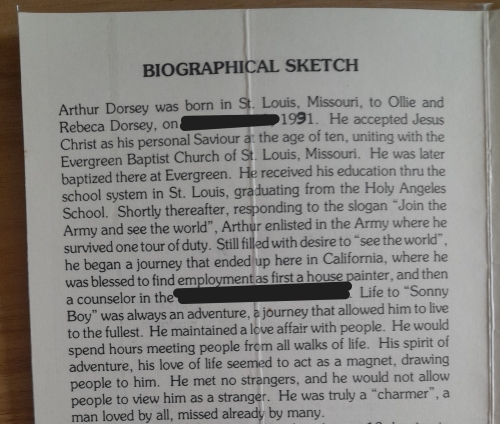
A portion of Arthur's obituary.
Obituaries are rich with information about the departed, and can include information on children, parents, siblings, birth and death dates, the funeral home, references to military service… all kinds of clues! I now knew his parents’ names, home church, school (and that he finished school), that he was in the Army, the types of employment he had, the names of all of his children and other living relatives (at the time), and even some personality traits that could give me a sense of who “Sonny Boy” was.
This allowed me to create a list of possible events, people, and institutions significant to his life. All of these things mean more records. More records mean more information.
His obituary also gave me the name of the funeral home that handled his service and the cemetery he was buried in. That’s SIX whole institutions that could have records relating to him:
- Evergreen Baptist Church
- Holy Angeles Schools
- the Army
- an employer
- the funeral home
- the cemetery
Now I could start reaching out to these places for records.
The Funeral Home and the Cemetery
First, I contacted the funeral home and cemetery. I hoped one of them would have records that could tell me who paid for his service. This could be the key to finding my other Dorsey relatives.
Unfortunately, the funeral home had already purged their records from 1991.
However! The cemetery had still records. They confirmed that he was cremated and the garden where his ashes were scattered. They knew who paid for his burial arrangements and offered to share my contact information with them. I’m hoping this individual is a relative from the other family.
Fingers crossed on that one.
The Death Certificate
Next, I ordered a copy of his death certificate from the California county he died in.
I love death certificates because they can provide a tremendous amount of information, including: birth and death dates, martial status, occupation, place of residence, causes of death, the names and places of birth for both parents, even the “informant” who confirms the death of the individual. I could go on for ages, seriously. But anyway, the “informant” is the person who provides the majority of the information on the death certificate. So, based on who the informant is, you can determine how reliable that information is.
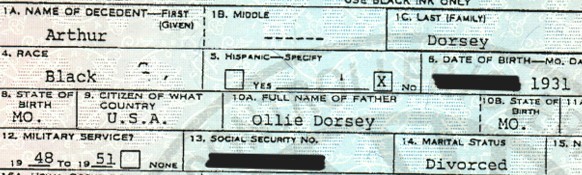
A snippet of Arthur's death certificate.
Let’s say the informant on a death certificate is the adult son of a deceased mother. Depending on the nature of their relationship, this son might know everything about his mother. We can assume that the information is likely highly credible. But if the informant just happens to be a neighbor, well, the information might not be as accurate as you’d hope.
In my experience, I’ve found that the informant is usually a relative or other individual who had a significant relationship with the deceased. This can help you reconstruct relationships, especially for female informants who no longer carry their maiden names!
But I digress.
To order a death certificate, you need to know at least the name of the individual and when and where they died. Once you have that information, you can order the record through the county of death or state of death. I usually prefer the former because it tends to get processed faster (there are less records to look through in a county vs. a state, after all).
Once I got his death certificate, I learned several new things, such as:
- His exact years of military service (helpful for securing his military records)
- His social security number (that’ll be important later!)
- How he died (a stroke and other causes)
- That he was divorced (this means more records!)
- His address at the time (note to visit when I go to Oakland)
- His level of education (could I find school records?)
- The industry he worked in
I was also able to confirm information I already had, like the name of his father.
And get this. One of my aunts was his informant. If I had any follow-up questions, I could just ask her.
The Army
From his death certificate, I learned that Arthur was in the Army from 1948 to 1950.
You can request military records from the National Archives and Records Administration (NARA), but it can take months for your request to be fulfilled. So, I reached out to local sources first: St. Louis County’s libraries, historical societies, and the recorder of deeds. But in the end, all of them recommended reaching out to NARA.
What I wanted was his official military personnel file (OMPF). This file would tell me all about his military experience: his training, his performance, health records, disciplinary actions, dates of enlistment and appointment, you get the idea.
But I hit a roadblock. In 1973, there was a fire at the National Personnel Records Center and over 16 million official military personnel files were destroyed. This was significant for me because this included about 80% of the records for Army servicemen who were discharged between 1912 and 1960.
As I learned from NARA’s response to my request, that likely included Arthur’s file as well.
But NARA did send me a certification of his military service, which confirmed the nature of his termination from service (“Undesirable Discharge,” which raises so many questions), how long he was in the Army, and his last rank.
I also did a quick search on Ancestry to see if he might have been picked up on a selective service record, also known as a draft registration card. Such records exist for male registrants between World War I through the Vietnam Era. These are also some of my favorite records because they give you physical descriptions of your ancestors and this is often the place where I see their signature for the first time.
Arthur did have one, which he filled out in 1950, just a couple of months after he left the Army.
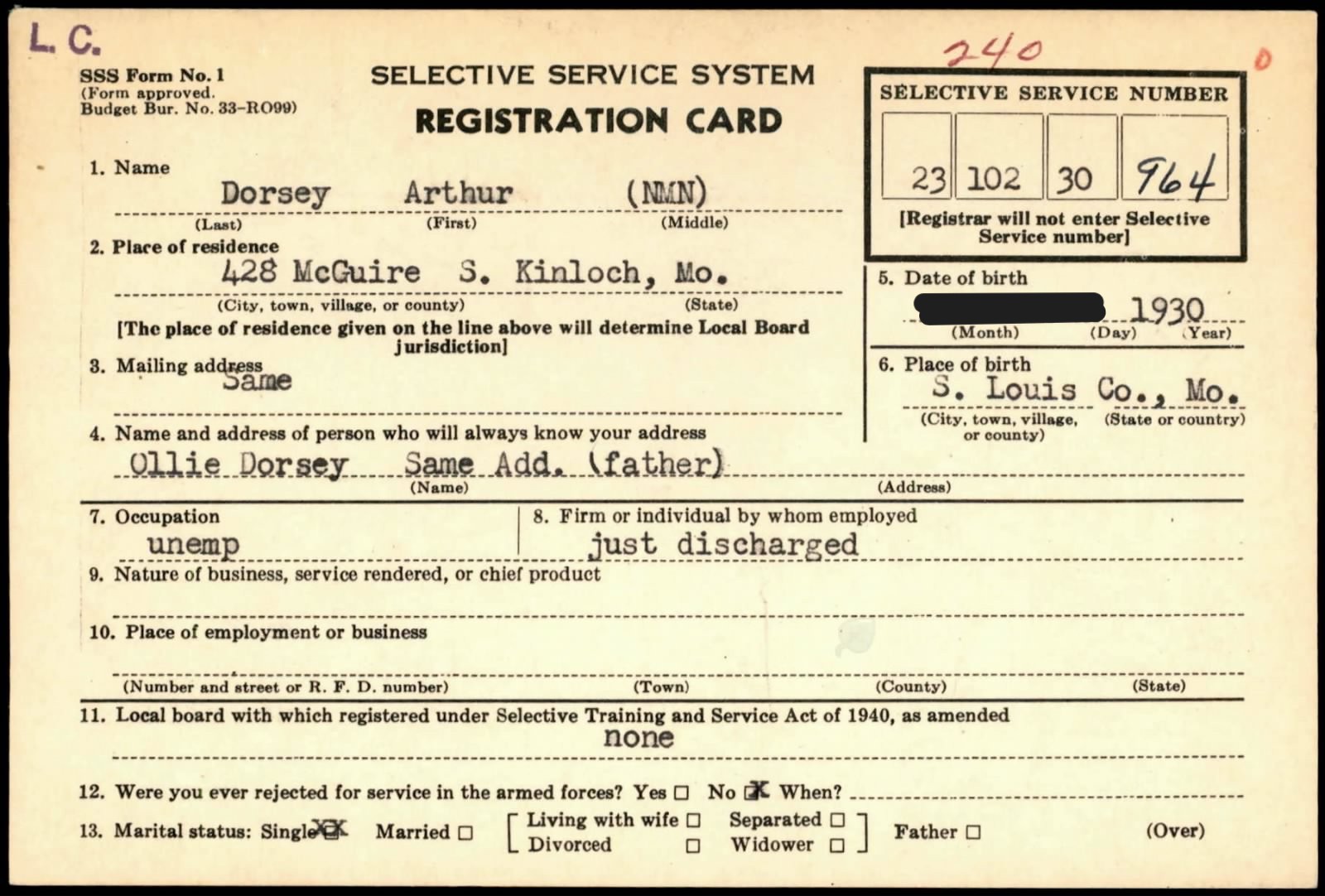
Arthur's Selective Service Record (National Archives at St. Louis; St. Louis, Missouri; Record Group: Records of the Selective Service System, 1926–1975; Record Group Number: 147; Series: Post-WWII through Vietnam Era Selective Service Records, Missouri; Series Number: 147-76-0298).
The other side of the card shows his signature:

Arthur's lovely signature on the back of the card.
And a general physical description of him at the age of either 19 or 20:
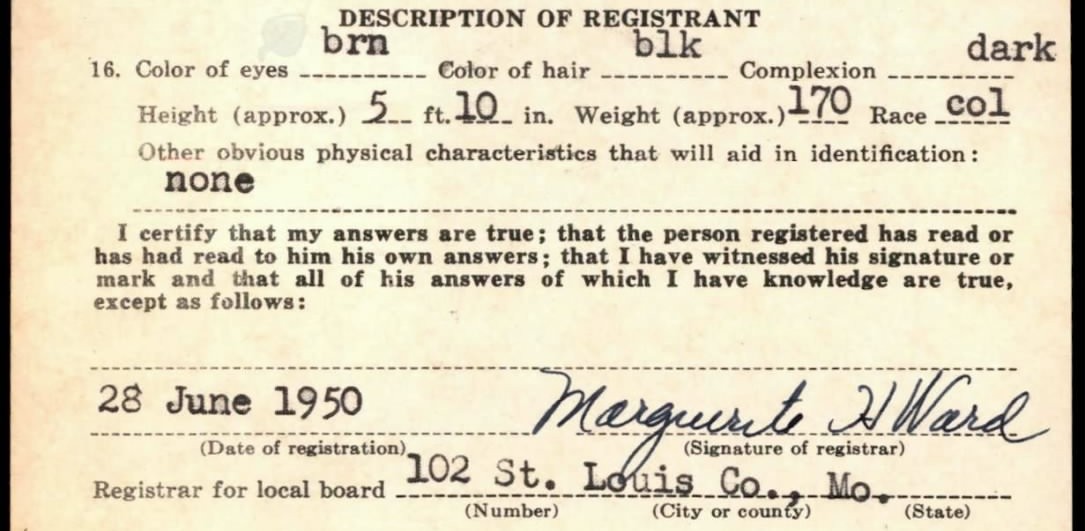
Arthur's physical description.
From this record, I learned:
- He had not married yet
- His physical description
- He had a lovely signature
- His service number while in the Army
And I was able to confirm for a third time, the name of his father, Ollie, and his street address in Kinloch.
Other Institutional Records
Next, I’ll start reaching out to his most recent employer, his school, and his home church. These records are a little trickier to access to because these specific institutions either now exist under a different name or don’t exist at all anymore. They also don’t necessarily have any obligation to maintain their archival records—they could be lost for all I know.
Stay tuned to see where I go from here. (A sincere thanks to the Arts & Science Council for their support of this research through an Emerging Creators Fellowship!)
Getting Started with Family History Research
If you’re interested in researching your own family history, to recap, this is my approach for learning more about Arthur:
- Start with what you know: Gather all the information you know about your ancestor.
- Work backwards from death: What do the records at the time of your ancestor’s death tell you about their life? Do these records mention any institutions (ie. funeral homes, hospitals, schools, churches)? Remember: institutions mean records. Records help provide clues and confirm information.
- Make a list of relevant institutions, people, and events: These are crucial to helping you identify more records and add context to your ancestor’s life.
- Seek records from the institutions: Reach out to each institution and request records. If the institution no longer exists, reach out to the local library, archive, or historical society for help. These places can also help you learn about the history of these institutions!
- Use the records to confirm information: Notice the similarities between records. What information can you confirm? What information conflicts?
- Keep track of what you find in a timeline: This will help you identify gaps, put together your ancestor’s story, and surface new leads!